
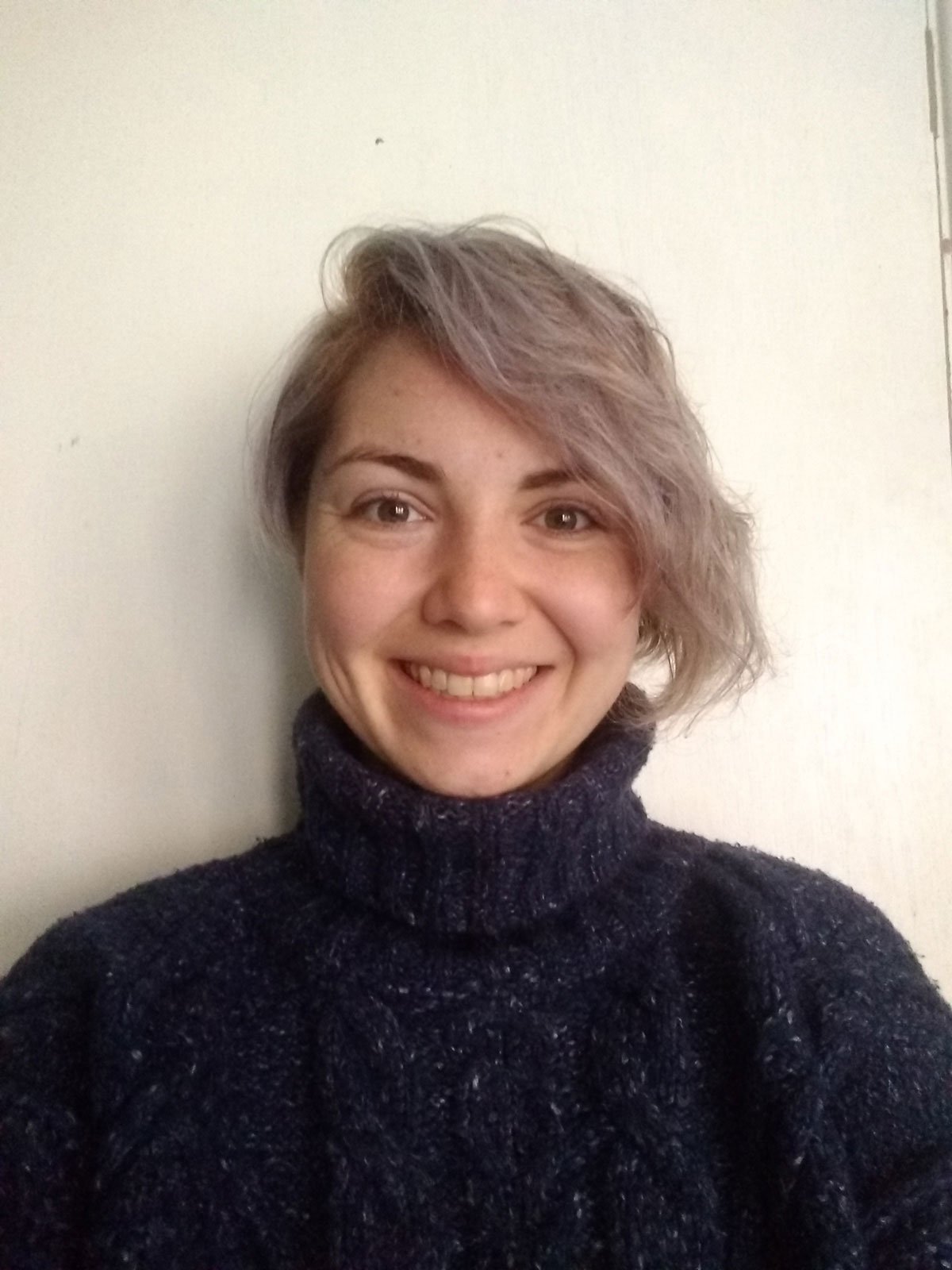
Caoimhe Kerins
I completed my BSc Biochemistry at University College Cork, Ireland, and MSc in Biomedicine at the Karolinska Institute in Stockholm, Sweden. During my Master’s degree, I moved to London to complete my thesis by Erasmus in the lab of Dr Selina Wray at University College London. I then stayed in London as a research technician at King’s College London (lab of Dr Katie Long). My interests are centred on in vitro modelling of diseases and the role of the extracellular matrix in disease.
Academic and Work Experience Prior to Sept 2020 Programme Start
I completed my BSc Biochemistry at University College Cork, Ireland, and MSc in Biomedicine at the Karolinska Institute in Stockholm, Sweden.
During my Master’s degree, I moved to London to complete my thesis by Erasmus in the lab of Dr Selina Wray at University College London. I then stayed in London as a research technician at King’s College London (lab of Dr Katie Long).
My interests are centred on in vitro modelling of diseases and the role of the extracellular matrix in disease.
PhD Programme- Year 1- MRes and Project Rotations
During my first year of the Wellcome Trust ‘Advanced Therapies and Regenerative Medicine’ Four-Year PhD Programme I rotated in 3 different labs:
The Chiappini lab: Investigating how nanoneedles can be used to modulate immune responses in mesenchymal stem cells
The Gentleman lab: Developing in vitro polyethylene glycol hydrogel models of aortic aneurysm
The Lieberam lab: Generating optogenetically controllable iPSC derived myoblasts (skeletal muscle precursor cells)
I learned a wide variety of skills during this first year including hydrogel culture, iPSC culture, electroporation, flow cytometry, handling of nanoneedles and cell culture on nanoneedles, use of various microscopes and deepened my knowledge of coding and bioinformatic analyses.
PhD Programme- Years 2 to 4- Doctoral Studies
For my thesis project I will be supervised by Dr Eileen Gentleman and Dr Ivo Lieberam. This project aims to understand the role of a type of neural extracellular matrix, the perineuronal nets in the selective resistance of certain neuronal populations to cell death in amyotrophic lateral sclerosis (ALS).
This project will involve a wide range of skills such as iPSC culture, mass spectrometry, atomic force microscopy and development of neuronal hydrogel cultures. I hope that this project will contribute to our knowledge of ALS pathology and clarify an unexplored area of ALS.

Cher Shen Kiar
At UCL, I received my undergraduate degree in Biochemistry with a Year in Industry undertaken at Protein Technologies group, GlaxoSmithKline Stevenage. In the past, I was fascinated by the mechanisms of molecular machines that are responsible for the correct functioning of cells. Under Dr Lisa Cabrita's supervision, I explored various methodologies to create 'snapshots' of protein biogenesis to probe the co-translational protein (mis)folding facilitated by the ribosomes. At GSK, I received excellent mentorship from Dr Maja Firczuk and Dr Michael Mullin; I was entrusted to lead the expression technology project which sought to improve mammalian protein expression and secretion through the design of regulatory genetic circuits.
Academic and Work Experience Prior to Sept 2020 Programme Start
At UCL, I received my undergraduate degree in Biochemistry with a Year in Industry undertaken at Protein Technologies group, GlaxoSmithKline Stevenage.
In the past, I was fascinated by the mechanisms of molecular machines that are responsible for the correct functioning of cells. Under Dr Lisa Cabrita's supervision, I explored various methodologies to create 'snapshots' of protein biogenesis to probe the co-translational protein (mis)folding facilitated by the ribosomes.
At GSK, I received excellent mentorship from Dr Maja Firczuk and Dr Michael Mullin; I was entrusted to lead the expression technology project which sought to improve mammalian protein expression and secretion through the design of regulatory genetic circuits. Here, I developed a high-throughput secretion assay and investigated the influence of differential codon adaptation in mammalian secretion efficiency. The experience was intellectually stimulating and rewarding for me as a scientist to contribute to the delivery of innovative, life-saving medicines.
PhD Programme- Year 1- MRes and Project Rotations
I spent my first year exploring various aspects of cell biology and regenerative medicine. In my first rotation supervised by Prof Francesca Spagnoli, I worked on developing CRISPR/Cas9 approach for ex vivo pancreatic culture and probing the influence of extracellular matrix in pancreatic development using ex vivo pancreas model. For the second rotation, I worked with Dr Subhankar Mukhopadhyay to explore the influence of malignant tissue signals on macrophage gene expression through single-cell RNA sequencing analysis. Finally, my third rotation supervised by Dr Alessandra Vigilante sought to build a bioinformatic pipeline for tumour-derived cell-free DNA, to identify predictive clinical markers for metastatic pancreatic cancer.
PhD Programme- Years 2 to 4- Doctoral Studies
Tissue-resident macrophages are highly heterogeneous populations of innate immune cells residing in all tissues as a dispersed organ, with crucial homeostatic, physiological and immunological functions. Their remarkable diversity is dependent on their developmental origins, tissue niche-specific signals and stimulus-dependent activations; however the underlying mechanisms for generating such diversity remain unclear. Studying these cells are difficult as they quickly lose their tissue specificity upon retrieval from specific tissue niches.
For my PhD project, I am working with Dr Subhankar Mukhopadhyay and Dr Andrew Bassett:
to establish methods for converting iPSCs into different tissue-resident macrophages,
to characterise the differences in their epigenetic and metabolic landscapes, and
to generate iPSC-derived ‘designer’ macrophages through synthetic biology approach and examine their preclinical safety and efficacy as cell therapy.
The overall goal for this project is to uncover the molecular control mechanism of diverse macrophage cell fates; with this understanding, we will pioneer the rational design and engineering of iPSC-derived macrophages as advanced therapy to address the unmet medical need in cancer, inflammatory-associated diseases and other macrophage-driven pathologies.

Imogen Brooks
At the Open University I studied for a Certificate of Higher Education in Natural Sciences. From there I went on to the University of Manchester to complete a BSc (Hons) in Developmental Biology. During my industrial experience year, I worked for 9 months at A*STAR in Dr Ernesto Guccione’s lab helping research PRDM10 activity in mouse embryonic stem cells. The summer after, I joined Peter Sarkies lab to work on selection pressure on chromatin condensation using C. elegans mutation accumulation models.
Academic and Work Experience Prior to Sept 2020 Programme Start
At the Open University I studied for a Certificate of Higher Education in Natural Sciences. From there I went on to the University of Manchester to complete a BSc (Hons) in Developmental Biology. During my industrial experience year, I worked for 9 months at A*STAR in Dr Ernesto Guccione’s lab helping research PRDM10 activity in mouse embryonic stem cells. The summer after, I joined Peter Sarkies lab to work on selection pressure on chromatin condensation using C. elegans mutation accumulation models.
For my final year project I joined Dr Sue Kimber’s lab to study TGFβ signalling in chondrogenesis by imaging SMAD2 localisation.
PhD Programme- Year 1- MRes and Project Rotations
During my first year I wanted to gain experience in a wide number of areas within stem cell research. I started in Prof. Georgina Ellison’s lab, looking at the effect of the four key cytokines upregulated in the COVID-19 cytokine storm in cardiac cells, to investigate why COVID-19 can lead to heart damage.
In my second rotation, I joined Dr Joanna Jacków and Prof John McGrath looking at recessive dystrophic epidermolysis bullosa (RDEB) and using base editor to correct mutations in RDEB patient fibroblasts. Additionally, I contributed to the writing of a book chapter on gene editing in skin disease.
In my final rotation, I joined Dr Eileen Gentleman’s group to look at the relationship between MMP-9, stiffness, and spheroid growth in breast cancer cells in synthetic hydrogels.
PhD Programme- Years 2 to 4- Doctoral Studies
For my PhD, I will be co-supervised by Prof John McGrath and Dr Joanna Jacków. My PhD project will be looking at RDEB, and autosomal recessive skin disease which results in skin fragility, blistering, and slow-healing chronic wounds. It has a high risk of mortality in young adulthood due to the prevalence of squamous cell carcinoma. The cause is mutations in the COL7A1 gene, which encodes Type VII collagen. The epidermis and the dermis are secured together in part by anchoring fibrils made of Type VII collagen.
Many attempts of the years have been made to edit the COL7A1 gene as a potential therapy for RDEB, but many mechanisms come by safety concerns. Over the course of my PhD I hope to test base editing and prime editing as tools for correcting COL7A1 with high efficiency and safety. I will look at editing patient derived iPSCs to determine if there is functional restoration of Type VII Collagen in the skin and prevent epidermal-dermal separation.
This work aims to advance the possibility of gene therapies for patients with RDEB.

Jessie Zihui Xu
I completed my BSc in Biochemistry at Imperial College London, during which I examined long-term balancing selection in low-coverage whole-genome sequencing data in the lab of Dr Matteo Fumagalli. Following this, I worked as a clinical AI data intern at SIME Diagnostics Ltd and collated electronic clinical data for neonatal respiratory diseases. I then pursued an MPhil in Genomic Medicine at the University of Cambridge, where I studied the involvement of DNA repair and apoptosis signalling pathways in anti-cancer drug responses using computational methods with Dr Mathew Garnett.
Academic and Work Experience Prior to Sept 2020 Programme Start
I completed my BSc in Biochemistry at Imperial College London, during which I examined long-term balancing selection in low-coverage whole-genome sequencing data in the lab of Dr Matteo Fumagalli. Following this, I worked as a clinical AI data intern at SIME Diagnostics Ltd and collated electronic clinical data for neonatal respiratory diseases. I then pursued an MPhil in Genomic Medicine at the University of Cambridge, where I studied the involvement of DNA repair and apoptosis signalling pathways in anti-cancer drug responses using computational methods with Dr Mathew Garnett.
PhD Programme- Year 1- MRes and Project Rotations
During my first year of the PhD Programme, I explored diverse research areas in the following labs:
The Gentleman lab: Restoring contractile phenotypes of vascular smooth muscle cells in 3D hydrogel models of aortic aneurysm
The Habib lab: Investigating the effect of ageing on Wnt-mediated osteogenesis and the healing bone environment
The Ali lab: Characterising the role of regulatory T cells (Tregs) in developmental immune homeostasis of the oral cavity
PhD Programme- Years 2 to 4- Doctoral Studies
For my thesis project, I have joined the lab of Dr Niwa Ali at the Centre for Stem Cells and Regenerative Medicine. The Ali lab primarily focuses on studying how tissue-resident immune cells affect tissue homeostasis and disease development. My PhD project aims to understand the crosstalk between Tregs and melanoma cancer stem cells and its contribution to the progression of melanoma skin cancer.
The project will primarily utilise in vivo model systems, but also cell culture, multi-colour flow cytometry, advanced molecular profiling including RNA-sequencing, qPCR analysis, spatial transcriptomics and tissue histopathology techniques. I hope that this project will deepen our knowledge of the regulatory mechanisms of CSCs controlled by Tregs and aid the discovery of novel Treg-based immunotherapies for the treatment of melanoma as well as other cancer types.

Maria Cristina Garrone
I completed my undergraduate degree at King’s College London, graduating with a BSc Biochemistry degree. As part of my bachelor’s degree, I joined Rocio Sancho’s lab for a summer research placement to work on the development of iPSC-derived pancreas organoid cell lines to investigate the role of pro-endocrine transcription factors regulating pancreas differentiation. For my final year thesis, I joined the Knight lab to study the role of the histone methyltransferase Ezh2 in tissue repair and organogenesis using a zebrafish in vivo model.
Academic and Work Experience Prior to Sept 2020 Programme Start
I completed my undergraduate degree at King’s College London, graduating with a BSc Biochemistry degree. As part of my bachelor’s degree, I joined Rocio Sancho’s lab for a summer research placement to work on the development of iPSC-derived pancreas organoid cell lines to investigate the role of pro-endocrine transcription factors regulating pancreas differentiation. For my final year thesis, I joined the Knight lab to study the role of the histone methyltransferase Ezh2 in tissue repair and organogenesis using a zebrafish in vivo model.
PhD Programme- Year 1- MRes and Project Rotations
During my first year of the Wellcome Trust ‘Advanced Therapies and Regenerative Medicine’ Four-Year PhD Programme I experienced different aspects of stem cell research. For my first rotation, I joined Dr. Eugene Makeyev’s Lab to investigate how long noncoding RNAs contribute to the maintenance of pluripotency and to the differentiation of pluripotent stem cells into neurons. In my second rotation, I was supervised by Prof. Francesca Spagnoli, I studied the mechanism driving direct lineage reprogramming of hepatocytes into pancreatic cells and its application in cell-replacement therapies. Lastly, in my third rotation in Dr. Rocio Sancho’s lab I focused on dissecting the heterogeneity of iPSC-derived pancreas organoids to better elucidate the differentiation potential of each population. Overall, the rotations taught me how to work with different cell lines, imaging tools and molecular biology assays and allowed me to develop skills in bioinformatics which I had no previous experience with.
PhD Programme- Years 2 to 4- Doctoral Studies
For my thesis project I will be supervised by Dr Rocio Sancho and Dr Alan Hodgkinson. This project focuses on modelling Congenital Hyperinsulinism (CHI), a rare monogenic disorder that leads to recurrent hypoglycaemia in new-borns due to endocrine β-cell dysfunction. By recapitulating this disorder in vitro using patient derived induced Pluripotent Stem Cells (iPSCs), I will investigate the effects of specific genetic variants during pancreas development, β-cell maturation and function.

Sofia Syntaka
I completed my undergraduate degree in Biology at the University of Crete, Greece. For my final year project, I investigated the impact of DNA damage accumulation on macrophages using a transgenic mouse model of ageing. Afterwards, I completed a MRes in Translational Neuroscience at University College London and Queen Square Institute of Neurology. For my thesis, I worked with Professor Sonia Gandhi at the Francis Crick Institute focusing on the generation of microglia from human iPSCs to investigate the role of neuroinflammation in Parkinson’s disease.
Academic and Work Experience Prior to Sept 2020 Programme Start
I completed my undergraduate degree in Biology at the University of Crete, Greece. For my final year project, I investigated the impact of DNA damage accumulation on macrophages using a transgenic mouse model of ageing. Afterwards, I completed a MRes in Translational Neuroscience at University College London and Queen Square Institute of Neurology. For my thesis, I worked with Professor Sonia Gandhi at the Francis Crick Institute focusing on the generation of microglia from human iPSCs to investigate the role of neuroinflammation in Parkinson’s disease.
PhD Programme- Year 1- MRes and Project Rotations
During my first rotation, I worked with Professor Benedikt Berninger at the Centre for Developmental Neurobiology, IoPPN investigating the reprogramming of human glia into induced neurons for brain repair.
In my second rotation, I worked with Dr. Ivo Lieberam at the Centre for Stem Cells & Regenerative Medicine (CSCRM) towards the development of a human iPSC-derived in vitro model of neuroinflammation. Specifically, we used forward reprogramming to derive astrocytes from patient-specific iPSCs and studied their involvement in Amyotrophic Lateral Sclerosis (ALS) in co-cultures with motor neurons.
In my third rotation, I worked with Dr. Subhankar Mukhopadhyay at the MRC Centre for Transplantation to investigate how the immuno-regulatory lipid mediator PGE2 modulates inflammatory responses in human iPSC-derived microglia.
PhD Programme- Years 2 to 4- Doctoral Studies
For my PhD project, I will work with Dr Ivo Lieberam and Professor Sonia Gandhi at the CSCRM and the Francis Crick Institute. The project will focus on iPSC-derived glial cells to uncover the role of neuroinflammation in ALS, a neurodegenerative disorder characterised by a progressive loss of motor neurons in the cerebral cortex, spinal cord and brainstem.